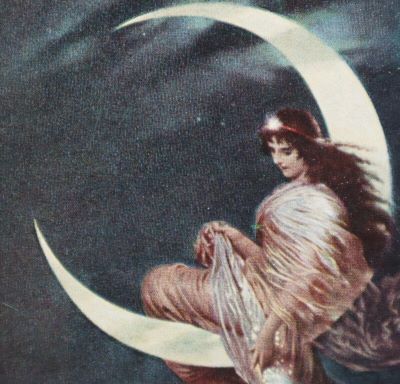
Celtic moon goddess Arianrhod.
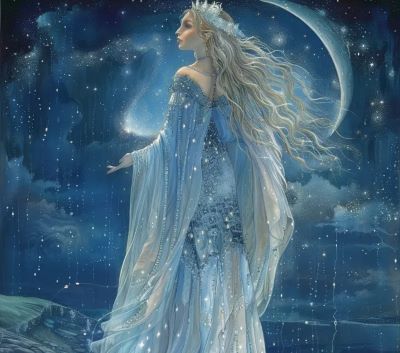
ARIANRHOD: Celtic Triple Goddess of Moon, Stars & Reincarnation – Woman of Owl Magic
As a Celtic Christian, I’m fascinated by how legendary women once remembered as goddesses later became saints. Perhaps they were actually early saints? Real-life women.
The main Celtic goddess who became a saint is Brigid, whose story and attributes were merged with Saint Brigid of Kildare. Other Celtic goddesses were likely Christianized, but Brigid is the most prominent example with clear connections between the pre-Christian deity and the historical saint.
And Arianrhod remains steadfastly locked in Celtic myth as a Goddess. There are no tales of her travelling the trails of Wales and Britain to bring the Gospel of Love to her war-torn people. Perhaps she is more Jungian than real.
Arianrhod, an Introduction
Arianrhod, known as the Silver Wheel, is a major Welsh goddess associated with the stars, the moon, and reincarnation. Her palace, Caer Arianrhod, is linked to the Aurora Borealis and the circumpolar stars. As a mother aspect of the Triple Goddess, she embodies beauty, fertility, and the cycles of life. This article explores her mythology, her roles, and her significance in Celtic culture, shedding light on lesser-known aspects of her story.
Arianrhod: The Silver Wheel
Arianrhod, whose name translates to “Silver Wheel,” is a significant deity in Welsh mythology. She is often depicted as a star goddess, with her palace, Caer Arianrhod, associated with the Aurora Borealis. This celestial connection underscores her role as a goddess of time, karma, and reincarnation.
The Triple Goddess, the Moon and Stars
Arianrhod’s association with the moon and stars is profound. The Celts, known for their astronomical knowledge, revered the moon as a symbol of the Mother Goddess. The Coligny Calendar, an ancient Celtic timekeeping system, was based on lunar cycles rather than solar ones. This lunar focus highlights the importance of deities like Arianrhod in Celtic culture.
The Palace of Caer Arianrhod
Caer Arianrhod, her celestial palace, is linked to the circumpolar stars. These stars, which never set, symbolize the eternal nature of the soul and its journey through reincarnation. Souls were believed to withdraw to Caer Arianrhod between incarnations, making her a goddess of the afterlife and rebirth.
Mythological Stories
Arianrhod’s mythology is rich with tales of magic, transformation, and familial conflict. One of the most notable stories involves her brother, Gwydion, and her son, Llew Llaw Gyffes.
The Birth of Llew Llaw Gyffes
Arianrhod’s brother, Gwydion, played a crucial role in her story. When King Math needed a new virgin to hold his feet, Gwydion suggested Arianrhod. To test her virginity, King Math asked her to step over his magic wand, resulting in the unexpected birth of a boy with yellow hair, named Dylan. A second child, hidden by Gwydion, was later revealed to be Llew Llaw Gyffes.
The Three Curses
Outraged by the circumstances of her son’s birth, Arianrhod placed three curses on Llew:
- He shall have no name except one she gives him.
- He shall bear no arms except ones she gives him.
- He shall have no wife of the race that is now on the earth.
Gwydion, determined to break these curses, used his cunning and magic to trick the Silver Wheel into naming Llew, arming him, and eventually providing him with a wife made of flowers, Blodeuwedd.
Symbolism and Legacy
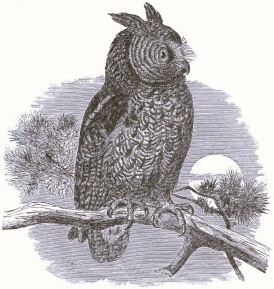
Arianrhod’s symbolism extends beyond her mythological tales. Like Minerva, Roman Goddess of Wisdom and War, Arianrhod was associated by owls. The owl was a creature symbolizing wisdom, death, and renewal. The owl’s ability to see in the dark mirrors Arianrhod’s insight into the human soul and subconscious.
The Owl and Moon Magic
Arianrhod’s connection to the owl highlights her role in moon magic and initiations. The owl’s nocturnal nature and its association with the moon align with the goddess’s dominion over the night and the cycles of life and death.
Modern Interpretations
Today, Arianrhod is celebrated in various neo-pagan and Wiccan traditions. Celtic Christians love her story. Her festival is observed on December 2nd, and she is honored during the full moon. Her story continues to inspire those who seek to understand the cycles of life, death, and rebirth.
Arianrhod: A Conclusion
Arianrhod, the Silver Wheel, remains a captivating figure in Welsh mythology. Her stories of magic, transformation, and the cycles of life continue to resonate with those who explore Celtic traditions. As a goddess of the stars, the moon, and reincarnation, Arianrhod’s legacy endures, offering insights into the ancient Celtic understanding of the universe.
Source References
“The pre-Christian world was the world of Celts, who worshiped Nature. To the Celtic outlook, the land was the great goddess. The rivers were her helpers and they enriched the earth. Celts used to live in forests. Sacred forests where they were close to Nature, learning the language of trees and wisdom of animals.” – SACRED FOREST: Sacred Groves, Celtic Spirituality & Celtic Christianity.
Judi Singleton, Athena, Minerva, Sulis: The Many Facets of the Divine Mother.
Wikipedia, Triple Goddess of the Celts.
Famous Bears, First Dog on Earth, Mythology & Folklore: visit Brian’s Blog right here.
Article “tagged” as: Caer Arianrhod, celtic goddess, mother goddess, triple goddess, Celtic goddess Arianrhod, Celtic moon goddess Arianrhod, Celtic Christian, Celtic spirituality before Christianity, wife made of flowers.
DID YOU LIKE THIS CELTIC SPIRITUALITY POST? IF SO, PLEASE SHARE WITH YOUR FAMILY & FRIENDS!