Bears in Mythology.
Bear Native American meaning…
BEARS IN MYTHOLOGY & FOLKLORE: Irish, Norse, German, Native American Meaning
Bear Myth: An Introduction
In mythology, bears symbolize strength, courage, wisdom, and rebirth. They were often seen as guardians, healers, or divine messengers. Bears were prominent in Indigenous Peoples of the Americas lore (strength, healing), Celtic/Norse/German tales (warrior spirit, transformation), and Greek myths (Callisto, Atalanta).
The big, shuffling animals embodied powerful, protective, and sometimes wild, untamed aspects of nature and humanity.
Even in modern times, their hibernation links them to cycles of death and rebirth. While their fierce maternal protection highlights themes of motherhood and family.
Worldwide Worship and Mythological Beliefs
Historically, bears have been both feared and revered. Anthropologists, including the renowned Joseph Campbell, have noted that bear worship dates back to prehistoric times, particularly among fishing and hunting tribes. The bear’s depiction in various cultures underscores its importance not just as a physical entity but as a spiritual symbol.
The Old World: Asian Reverence
In many cultures, bears are seen as more than just physical being. They are carriers of spiritual wisdom and healing powers. The Ainu people of Japan, for instance, practiced a ritual called “Iomante,” where they believed sending a bear’s spirit back to the heavens brought blessings and good health to their community.
India: Bears represent power, courage, wisdom and leadership. While also featuring in tales that highlight their connection to the divine. Bear mythology in India centers around Jambavan (aka Jambavat). Known as the “King of Bears” or “King of the Himalayas,” Jambavan is an immortal character who was present during the “churning of the ocean” and the killing of the asuras (demons) Madhu and Kaitabha.”
China: Early Chinese mythology featured bear worship, treating them as “Lord of the Animals” in northern areas. Black bears were often associated with powerful deities and transformation myths. Bears in Chinese culture symbolized a complex mix of raw strength, courage, and — through the Panda — peace and Yin-Yang harmony. While bears were historically revered in the Han Dynasty of 2000 years ago, in modern times they are often culturely presented as clumsy and comedic.
Korea: Bears are symbolic animals where legends speak of gods and transformative challenges, highlighting the bear’s role in cultural and spiritual tests.
The New World: A Symbol of Strength and Courage
Historically, bears have been admired for their strength and bravery.
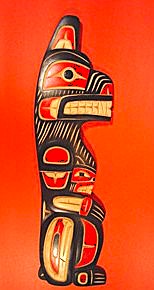 Indigenous nations of the Americas have regarded the bear as a powerful totem animal. Particularly those in the Northern regions like the Inuit.
As well as peoples of the East and West coastal forests. On the Atlantic coast: Mi’kmaq, Wolastoqiyik and Peskotomuhkati. Pacific coast: Haida, Tsimshian, Squamish Nation and Coast Salish peoples.
(Left) “Red Bear Wood Carving by Cody Mathias of Squamish Nation.”
These Indigenous people believe that the bear has a special connection to the earth and possesses qualities that humans can learn from, such as resilience and endurance in the face of adversity.
The Pacific Coast people tell the story “The Woman Who Married a Bear.” In it, a chief’s daughter weds a bear and gives birth to human-bear twins. This legend dramatizes the close relationship between Humans and Bears. Many clans trace their ancestry to this union and portray the bear as a key family member.
Bears in Greek Mythology: Divine Motherhood & Sacred Renewal
In Greek mythology, the Bear (Arktos) symbolizes the untamed wilderness, divine motherhood, and a sacred, transformative power. A power frequently linked to the goddess Artemis and the transition of young girls into adulthood. Bears were considered half-human, representing the boundary between wild nature and domestic life.
Callisto and the Stars
The myth of Callisto, a nymph and follower of Artemis, is central to bear symbolism. After Zeus raped her, a jealous Hera transformed her into a bear, and Zeus later placed her in the sky as the constellation Ursa Major (the Great Bear) to save her.
Atalanta and the Mother Bear
“I want a son!” Iasus of Arcadia told his wife. When his wife Clymene gave birth to a girl, he snatched up their child and stormed out into the street. The nobleman struggled up Mount Parthenion. And there, amid pine and juniper trees, and spiny spurge, he lay the newborn on the rocky ground. Where he abandoned her.
And there, Aftíarkoúda, attracted by woeful cries, found her. Aftíarkoúda was a brown bear. A mother bear whose cubs had been killed by local hunters. She picked up the human child. And fed her, as mothers do.
The bear sheltered the child. Protected her through her helpless years. And then taught her the ways of the wild.
But the time came when the bear knew that her adopted daughter must be among her own people. If you have been with bearkind much, you know that they can smile. If you had been with big Aftíarkoúda that day, you would have learned that bears can shed tears. With great sadness, the loving mother took the girl to the forest home of the hunters and left her at their door.
The hunters named her Atalanta, which meant “Enduring.” They clothed her and gave her a bow and arrows. They were amazed at her strength, her speed and her knowledge of the hunt. Soon she was the best hunter among them. Her skills caught the attention of kings and gods and the rest is mythology.
Northern Europe’s Veneration of Bears
Finland: Bears are considered kin to humans, believed to be the spirits of forefathers. Older beliefs of bears in mythology thought that Humans and Bears were connected by blood. A Northern assumption that Bears were Humankind’s closest relative. Some stories told of mixed-blood newborn.
This profound respect is evident as the bear is Finland’s national animal. The Finnish language has over 100 different names for bears, each reflecting different cultural significances.
Otso Bear Mythology: In Finnish mythology, Otso (also known as Karhu, Ohto, Kontio and Mesikämmen) is a bear, the sacred King of Animals and Leader of the Forest.
In fact, the mighty Bear was the King of Animals for many Northern European cultures. It wasn’t until the Roman Conquest of the Northern nations that the Bear was replaced by the African Lion as the symbol of the powerful ruling royal families.
Russia: In the Russian fairy tale “Morozko,” a villain punished with a bear’s head symbolizes societal ostracization, illustrating the bear’s role in teaching moral lessons.
Scotland: Old Scottish stories told of the Celtic goddess Artio (Goddess of the Wild) and the warrior-king Arthur, with “Artos” meaning bear in Celtic. Bears went extinct in Scotland (hunting and habitat loss) about 1000 AD. Two centuries later King William the First adopted the African Lion as Scotland’s Royal Emblem.
Ireland: In the Irish language, “beithir” could mean both bear and warrior, while “béar” could also mean tyrant or invader, highlighting the animal’s complex symbolism. Names like O’Hart (descendant of Art) and places like the Beara Peninsula reflect ancient connections. Artio the Bear Goddess was a prominent Celtic deity. She represented fertility, abundance, and the cycle of life, death, and rebirth. In stories, she was as a forest guardian.
Alpine Legends and Traditional Western Narratives
In the Alpine regions, legends like those of St Corbinian and St Romedius depict bears as both tamed beasts and helpers, signifying a harmonious relationship between humans and nature. These stories not only reflect historical attitudes but also underscore a mutual respect and dependency.
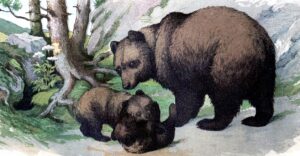
Bears in Germanic Mythology
In Germanic mythology, the bear symbolized immense strength, courage, and warrior spirit. Often seen as a powerful forest deity or spirit, leading to warrior cults like the berserkers who wore bear skins and invoked its ferocity.
Bears were totemic, feared and respected, with euphemisms used in place of their true name, and connected to shape-shifting tales like Bödvar Bjarki in Northern German sagas, linking them to shapeshifting warrior figures in German folklore too, as in the Brothers Grimm “Bearskin” tale.
Are there bears in Germany?
“Problem bears” such as Bruno (who wandered in from Italy in 2006) still catch the German fancy.
German zoos house various bear species, primarily focusing on Polar Bears (like at Berlin, Tierpark Berlin, Hellabrunn, Karlsruhe) for conservation and public engagement. And Brown Bears (Zoo Berlin), often participating in European Endangered Species Programs to preserve genetics.
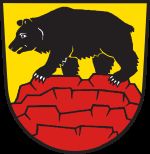
The German city of Berlin (which means “Bear”) has a black bear on its civil flag. The German towns of Bärenstein, Bernau bei Berlin, Freising and Werdau feature bears on their coats of arms. The Swiss capital city of Bern also has a bear on its flag.
Bears in Modern German Writing
A number of modern German writers have written some essential works on bears and wildlife in mythology. Recapturing our connection with Nature and Spirituality. Wolf D Storl is one. [1]
In his book BEAR: Myth, Animal, Icon, Wolf D. Storl explores bears in mythology. Their deep significance across cultures, viewing it as a powerful “forest human,” deity, or ancestor. All linked to seasonal cycles, fertility, strength and transformation. Contrasting pagan reverence with Christian interpretation, and connecting ancient lore (like Celtic bear goddesses) to modern symbols (like teddy bears). And to indigenous traditions.
Storl dramatically reveals how myths portray bears as more than animals, but as powerful forces embodying wilderness and wisdom.
The Mama Bear Leitmotif: Bear as Protector
The protective aspect of the bear is evident in its frequent role as a guardian in folklore and myth. For example, in some Native American stories, bears are portrayed as protectors of the forests and their inhabitants. This protective trait is also reflected in how some modern societies view and conserve bear populations, recognizing their critical role in maintaining ecological balance.
Certainly the mother bear fiercely defending her young is a modern trope in places where bears still live and thrive. “You can go in the woods, but don’t get between a mama bear and her cubs!”
Bears in Modern Symbolism
Today, the bear continues to be a potent symbol in many cultures, often representing national strength and resilience. The Mama Bear theme, especially, is as potent as it was thousands of years ago.
Are you as spellbound by Bears in Mythology & Folklore as I am?
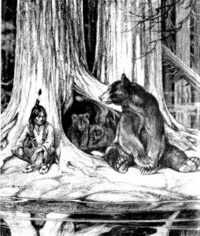 If so, you’ve got to read my popular short story “THE BOY WHO WAS RAISED BY BEARS.” A Traditional First Nations Animal Story & Folktale Retold.
Talking bears and human children adopted and raised by loving mother bears are common story themes in both Old and New World oral traditions. Even J R R Tolkien wrote about both Beowulf and “Bear’s Son Tales in European folklore.”
“Loved this beautiful Animal Tale. Loved Giju’muin, the strong Mama Bear. Perfect!” BOY WHO WAS RAISED BY BEARS Native American Myths & Legends Bear Story
“Live Free, Mon Ami!” – Brian Alan Burhoe
[1] Such as author and artist Kurt Wiese. Who illustrated many animal stories, including Felix Salten’s BAMBI, A Life in the Woods and his own BUDDY THE BEAR. I have written, “Like so many Germans, Kurt Wiese seemed to be born with a deep affinity for wild animals and wild places.”
Bären in Mythologie und Folklore: Irische, Nordische, Deutsche und Kanadische Ureinwohner
FURTHER READING:
- THE BEAR: History of a Fallen King by Michel Pastoureau, 2007
- BEAR: Myth, Animal, Icon by Wolf D Storl, 2018
- “Understanding the Symbolism of the Bear” by Lisa Jeeves, 2024
TEXT SOURCES: “I chose wild, untamed nature and from then on, I spent every free minute in the forest, in the great outdoors. There was an entire universe to discover.” – Wolf-Dieter Storl.
“Bears have held a significant place in the mythology and spirituality of numerous cultures throughout history. In many traditions, bears are seen not just as wild animals but as important symbolic figures with various meanings attached to them.” – Lisa Jeeves.
“The pre-Christian world was the world of Celts, who worshiped nature. To the Celtic outlook, the land was the great goddess. The rivers were her helpers and they enriched the earth. Celts used to live in forests. Sacred forests where they were close to the Nature, learning the language of trees and wisdom of animals. SACRED FOREST: Sacred Groves, Celtic Spirituality & Celtic Christianity.” – Brian Alan Burhoe.
IMAGE SOURCES: “Red Bear Wood Carving by Cody Mathias of Squamish Nation” compliments of Free Spirit Gallery, 2012. Pen and ink drawings are all from Project Gutenberg.
EDITOR’S NOTE: Although the bears on this post are drawn from old mythologies, Project Gutenberg and modern AI search, some may have a Civilized Bears sensibility…
TAGS: Bear in Mythology, Bear mythology names, bear god names, Celtic bear meaning, civilized bears, famous bears in mythology. Names of bears in mythology, bears in mythology Norse, Bears in Greek Mythology, Irish bear mythology, Canadian First Nations.
DID YOU LIKE THIS BEARS IN MYTHOLOGY POST? IF SO, PLEASE TELL YOUR FRIENDS. SHARE THE STORY!