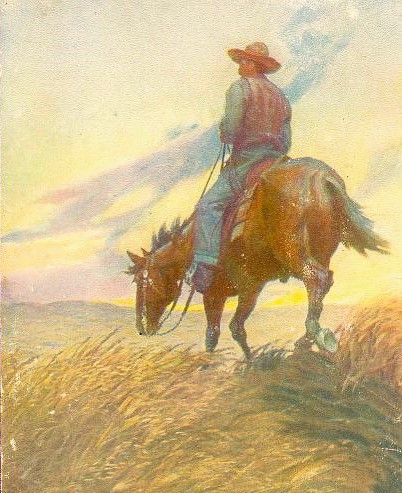
Tom West, classic ACE Double Western writer — a Remembrance.
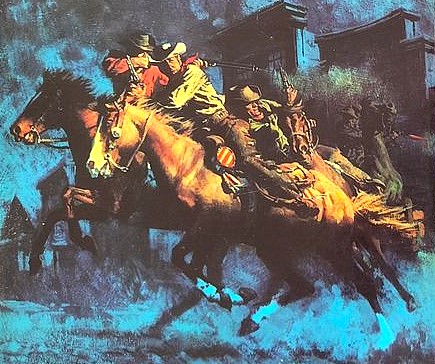
TOM WEST: Classic ACE Double Western Writer Remembered
In his 1960 Western novel THE PHANTOM PISTOLEER, after a ranch house, barns, blacksmith shop and wagon shed are burned flat to the ground, we read: “Wal,” said the foreman wryly, “there’s less cover for the coyotes.” Tom West, folks…
If I were to list my Top 10 Movies of All Time, four of them are Westerns. Rio Bravo, the original True Grit, The Shootist, and The Good, the Bad and the Ugly. [1]
Why not? I’m a Boomer and we grew up with ’em. Most Saturdays, we eagerly lined up outside the Paramount and Strand Odeon theatres to catch the matinee. “Sure loved them old Westerns!”
Our heroes rode hard and fought hard to bring right and justice to the Old West. Sometimes they sang about it. Sometimes they even kissed the girl.
And our libraries and paperback book racks were filled with classic and new fiction by the best frontier authors.
I had already discovered wilderness writers like Charles G D Roberts, Grey Owl, Jack London, Ernest Thompson Seton and Edgar Rice Burroughs. From there it was a quick jump to Zane Grey and Max Brand.
But the first Western writer I’d say was a true hero of mine was Tom West. Still is.
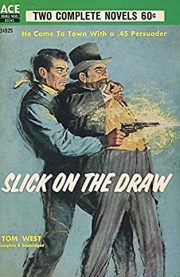 As a kid, I saved my paper route and summer job money and bought those ACE Double Books. You know, those great little paperbacks that have a “Complete Novel” on one side. Then — after flipping it over — a “First Book Publication” on the other.
With the ACE Double Westerns, I met tale-tellers like Ray Hogan, Giles A Lutz (aka Reese Sullivan), Gordon D Shirreffs, Louis Trimble, Nelson Nye, Merle Constiner, L P Holmes…
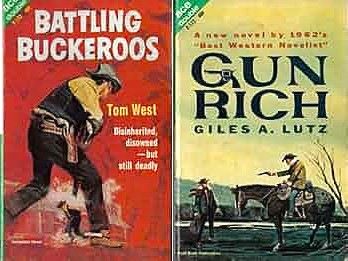
Giles A Lutz, a rancher in real life who raised Black Angus cattle, was almost an opposite of Tom. Giles wrote of more ordinary wranglers and sodbusters struggling to make a living in a hard land.
His THE WHISKEY TRADERS and THE HONYOCKER are permanent personal picks.
But Tom West quickly became my fave Western writer.
What really caught my attention, besides the fast action and old fashioned romance, was West’s language.
Tom West’s typical hero didn’t just walk through the swinging doors into a saloon to look for the man who had shot his friend. He “pushed through the batwings to lamp and plug the deadly sidewinder who’d beefed his pard.”
And Tom West had something those others rarely showed: humour.
At that time, I was growing up in harness racing country of New Brunswick. In the rolling hills of the Northern Appalachians. Amid a mixed crew of old horsemen, blacksmiths, farmers, lumberjacks, highways workers, most of who were War Vets. Three things those guys had in common were a willingness to work damned hard, their own language and a real sense of fun and humour.
And that’s where Tom West’s novels seemed so real to me.
Later, I would discover the books of Clarence E Mulford of Hopalong Cassidy fame, which had the same reality.
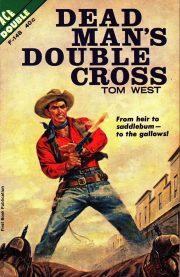 Who was Tom West? Western writer and keeper of the faith James Reasoner has said that Tom West “was really an Englishman named Fred East.”
The few brief bios at the beginning of his published works like THE BUZZARD’S NEST and DEAD MAN’S DOUBLE CROSS say that London-born East had been severely injured while serving in the British Army on the bloody, barren battlefields of France during the First World War.
“Discharged in his early twenties, he returned home packing a dirty kit bag. The bag contained, among other things, the manuscript of a war novel that he had painstakingly tapped out on an old typewriter during the weary months in the military hospital. The following morning he awoke to find that his mother, to whom cleanliness was next to godliness, had burnt the dirty kit bag and its contents. Thus his first literary effort met a fiery fate.” (While written in the third person, this quote has a distinct “Tom West” feel.)
After that, East moved to the US to further recover his health and find adventure and work. He took a number of hardscrabble jobs, including as “choreman, teamster and puncher on ranches in the California west.” Then he went back to his literary dreams, working for years as a reporter, freelance writer and a book editor.
Some of his writing assignments took him back to Europe. In fact, in later years, friends would remember his love of foreign travel.
And then he set out to write Western fiction.
In 1944, at age 59, he published his first full-length novel, going on to write well over sixty more.
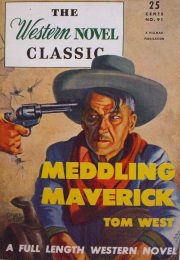 The Catalog of Copyright Entries for 1944 shows that the novel MEDDLING MAVERICK was written by Fred East (1885-), under the pseudonym Tom West, and published in hardcover by E P Dutton & Co of New York. It was reprinted later that year as a Hillman Publication Western Pulp Magazine Digest. An instant “Classic.”
MEDDLING MAVERICK was followed in 1945 by BUSHWHACK BASIN, also from Dutton.
Fred East also published some early works under other names. He saw GAMBLER’S GOLD, a Powder Valley Western, published by Jefferson House of New York in 1946 under the house name Peter Field. And a number of books under the by-line Roy Manning: TANGLED TRAIL and RENEGADE RANCH from Macrae-Smith Company of Philadelphia in 1948.
Soon, he was writing paperback originals for ACE Books.
By the mid-Sixties, the writer known mostly as Tom West had achieved enough success to live out a dream. With their grown son and daughter both living fulfilling lives, Fred and his wife Mildred were able to spend much of their time “roaming California, Arizona, Utah and other Western states in a trailer.”
And writing more Western novels.
Not certain when Fred East died. One source tentatively says 1983, two years short of his 100th birthday.
The US Copyright Encyclopedia shows that Mrs Fred East (Mildred F East) was still renewing Fred’s copyrights (on both Tom West and Roy Manning authored works) as late as 1995.
The last new published titles from ACE Books under Tom West’s name were SHOOTOUT AT SENTINEL WELLS (1974) — and PAYOFF AT PIUTE in 1977, when the Great War vet would have been age 92. His last published works were at the end of the decade: SAGEBRUSH SHOWDOWN (Zebra Books, 1979) and HARD TRAIL TO SANTA FE (Zebra Books, 1980).
Although the storylines in the last few of his published works were typical Tom, the writing was somewhat flat. Not his rip-roarin’ individualist Old West voice (and laconic hardbitten characters) of a man still in his youthful eighty-somethings. It’s possible that these last books were written by others, using the then-popular Tom West name.
Tom West is mostly forgotten now. Humour doesn’t seem to work for modern editors? Maybe. All I know is that Tom — East or West — sure reflected some of the old guys I grew up with. And that makes him a personal “Best.”
Live Free, Mon Ami! – Brian Alan Burhoe
“Here’s an excellent blog post about Tom West with reviews of some of his books.” Western writer James Reasoner
To see my complete ARCHIVED EDITION of this Post, including Book Reviews and my typical meandering Footnotes, go to…
Tom West: Classic Ace Double Western Writer Remembered & Reviewed.
And see one of my most popular pages on this new incarnation of CivilizedBears.com:
Bears, Wolves, Dogs & Mounties: The Canadian Northwestern Genre & Pulp writers.
[1] “My Top 10 Movies of All Time, four of them are Westerns…”
If you count Northwesterns (aka Northerns) as Westerns, then you can almost double that number: The Wild North (with Wendell Corey as real-life Constable Albert Pedley), Call of the Wild (Charlton Heston version) and Grey Owl (in this biopic Pierce Brosnan perfectly caught the character of wilderness writer Grey Owl).
Here’s what I believe: those old tales, those Westerns and Northwesterns, were among the best darned adventure tales ever told. – Brian
TAGS: #ClassicWesterns, ACE Double Western, Fred East, Giles A Lutz, James Reasoner, Max Brand, Mildred F East, Roy Manning, Tom West, Western writer, wilderness writer.
DID YOU LIKE THIS WESTERN WRITER POST? IF SO, PLEASE SHARE WITH FRIENDS & FAMILY! SPREAD THE WORD!