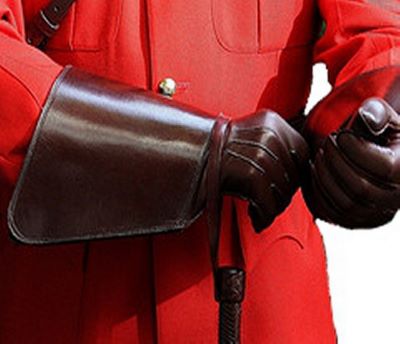
Adventures of the Royal Mounted Police.
Royal Mounted Police novels by Ralph Selwood Kendall, Grosset and Dunlap
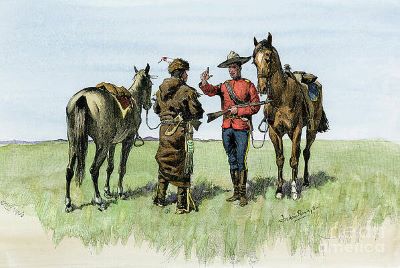
BENTON OF THE ROYAL MOUNTED by Ralph S Kendall – Book Review – LUCK
“The scenes of this story belong to bygone days. As the passer-by views the ugly half-constructed railway terminus which now sprawls itself over the original site of that historic group of Police buildings, known as the ‘Post,’ little does he appreciate the pangs of real regret which stir the hearts of old members of the Force, as they recall associations of earlier years.” Ralph S Kendall, Foreword to BENTON OF THE ROYAL MOUNTED, 1918
About Ralph S Kendall
Ralph Selwood Kendall was born in Birmingham, England, April 20, 1878. He was the son of Esther Catherine and George Barraclough Kendall. And he was educated at Solihull School, Warwickshire, where two members of the Tolkien family have been students and a third has taught.
Aged 22, Ralph saw active service in the South African War (Boer War), 1900 to 1902. He served as a Private in the 22nd Cheshire Yeomanry and Younghusband’s Horse. And he was awarded the Queen’s Medal with Bars for service in Transvaal, Cape Colony and Orange Free State.
Ralph arrived in Canada in 1902. He settled first in Maple Creek, a frontier settlement in the green-forested Cypress Hills of southwest Saskatchewan. Then moved on to the thriving “Cow Town” Calgary, Alberta in 1905. There he joined the Royal North-West Mounted Police (Regimental Number 4351).
As a Mountie, Ralph Kendall served in Banff and Laggan (later called Lake Louise) before returning to Calgary as a Sergeant.
He married Kate McEachran of Montreal in 1909. Their permanent address was 211 Third Avenue, West, Calgary. In 1910, Ralph transferred from the RNWMP to the Calgary City Police Mounted Unit, as Sergeant-in-Charge. He retired from police work in 1924.
From 1924 to 1939, he was a Court Orderly at Calgary.
Where he met such people as Lord Byng (Canada’s Governor General, who as Commander of the Canadian Army Corps had led our victory at Vimy Ridge) and the Prince of Wales (later King Edward XIII). Ralph Kendall died February 5, 1941. He was buried at the Union Cemetery.
Kendall Place, Calgary, “a quiet locality in the heart of Kingsland,” was named in his honour.
Ralph was proud of his service and the many friends he made in the different units. He wrote two full-length novels about his Mounties: BENTON OF THE ROYAL MOUNTED (1918) and THE LUCK OF THE MOUNTED (1920). The veteran dedicated them both “To MY OLD COMRADES Present, and Ex-Members of the R. N. W. M. POLICE, This Work is Dedicated With Every Kind Thought.”
I am reviewing BENTON OF THE ROYAL MOUNTED written by Ralph S Kendall.
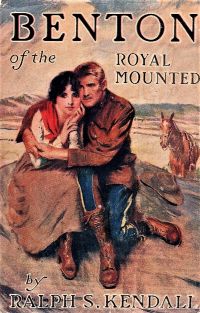 BENTON OF THE ROYAL MOUNTED: A Tale of the Royal North-West Mounted Police, Nov 1918, John Lane Co., London — Grosset and Dunlap, New York — S B Gundy, Oxford University Press, Toronto.
There was silence for a moment or two, during which the O.C. rummaged amongst some letters on his desk. He found the one he wanted and scrutinized it carefully.
“Sergeant Benton,” he began, with a sudden snap in his tones and a quick upward glance that strung that individual up to tense expectancy, “I have here a letter — an anonymous letter — accusing you of grossly and maliciously assaulting a well known and respected citizen of Elbow Vale on the night of the twelfth instance…. Motive unknown — all names — with the exception of your own — omitted. Said assault of such severe character that its recipient is still confined to bed.
“Now!… although I generally make a rule of treating anonymous correspondence with the contempt it deserves — there seems something vaguely familiar in this handwriting that inclines me on this occasion to revoke my usual practise, and make a few inquiries into this puzzle. I look to you for the key. You have the reputation of being a truthful man in this Division… Is the statement in this letter correct?”
Benton hesitated. “As far as the assault goes, yes, sir,” he said finally.
Born into a proud English Cavalry family, and restless by nature, in younger years Ellis Benton had fought in the South African War, tried prize fighting in America (was good enough at it but didn’t like that it was a crooked game) and worked as a cowboy on ranches in Montana and Wyoming.
After meeting some Canadian Mounted Police in his range riding, he decided he liked the idea of becoming a “Prairie cop,” and rode North to join the Force. As a British citizen, a decorated cavalry veteran and experienced in prairie ranch work, he was readily accepted.
He was, as Superintendent Richard Bargrave, Officer Commanding of L Division, suspected — a man of honour. He was also a proud man, quick to enter a fight. So Bargrave, who among the men themselves was called “Father,” decided: “I do not think it would be good policy to send a man with your pugilistic tendencies back to this locality.”
“Let’s see — you’re a good range man. I think I’ll transfer you to Cherry Creek…”
When his comrades later asked the OC’s decision, Benton said, “Banishment — physically, socially, and morally… Father intimating in his own happy fashion that I wasn’t quite civilized enough to hold down a Line detachment… Cherry Creek!… O Lord!”
And so we get to know Sgt Ellis Benton. Your average fictional Mountie of a century ago tended to be a virtuous man. A man of honour, valour and even Muscular Christianity. He never started a fight. Like a Boy Scout, he was clean in thought, word, and deed. Benton is a surprise. Quick tempered, he’ll start a fight, throw the first punch.
When he enters the Police Post canteen, the author tells us: “Their day’s duty over, careless and jovial they sat, amidst the tobacco-smoke-hazy atmosphere, smoking and drinking their beer and exchanging good-natured repartee which occasionally was of a nature that has caused a certain great writer to affirm, with well-grounded conviction, that ‘single men in barracks don’t grow into plaster saints’.”
Ellis Benton trades them word for word. When Benton says “D__m,” and “H__l and even “____” we know what he’s saying.
And the beer flows and Sgt Benton sits at the piano. The hard lines of his face soften with an expression of bonhomie and he sings Kipling’s old soldier’s song of Mandalay:
Ship me somewhere east of Suez,
Where the best is like the worst,
And there aren’t no Ten Commandments
An’ a man can raise a thirst…
And here’s part of the magic of BENTON OF THE ROYAL MOUNTED: Ralph Kendall is going to tell us what it was like to be a real “rough and ready” Mountie at the turn of the 20th Century. And Sgt Ellis Benton quickly becomes a genuine Canadian cultural hero.
“I think I’ll transfer you to Cherry Creek…”
Cherry Creek district was in the middle of Ranch Country and we’ll meet hard-faced ranchers, lean cow punchers and devious, dangerous cattle rustlers as Benton makes his patrols on his big black horse, Johnny.
Benton knew about some of them: “Big George’s some bad man. I’ve got his record from over th’ Line. He’s done two fives an’ a three year term for horse-stealin’. I know for a fact, too, that he’s a gun artist. He killed two men in a dirty mix-up at Los Barancedes, over in New Mexico…”
And there’s the cattle killer, one William Butlin, generally known in the district as “Short and Dirty” or just “Shorty.”
But there’s good folk also. “Old Dog-face” Gallagher, a small rancher with a genial smile, who has the Mountie’s back when the lead flies.
And there’s Mary. When he first meets the “tall, magnificently-built, dark girl, eyeing him and Johnny with eager curiosity and admiration,” Mary’s stout, petulant Aunt appears and, calling Benton “just a policeman,” leads her away. He’ll meet Mary O’Malley again.
I’m not going to tell you how it all ends, mon ami.
Read it for yourself. Kendall used a lot of his own life in this ol’ yarn — almost autobiography — so you’ll find hints in his own bio.
The final pages give us a Glossary. Why? The Old West was a vast land of many tongues. Besides English, French, Spanish and assorted First Nations words, Canadian men who had served in the South African War now also spoke phrases in Dutch Taal, Bantu and Zulu. Interesting times!
Ralph Kendall’s BENTON OF THE ROYAL MOUNTED is one of the great novels of it’s age.
A masterwork. And worth hunting down for your Canadiana bookshelves. A must for Canadian Patriots.
BOOKNOTE:
Along with Samuel Alexander White’s novel LAW OF THE NORTH (Originally published as EMPERY), Ralph Kendall’s two MOUNTED books were collected in the All-Canadian NORTHERN TRAILS OMNIBUS: Three Complete Novels of Adventure in the Northwest, Published by Grosset and Dunlap, New York, 1920, reprinted 1939.
Live Free, Mon Ami! – Brian Alan Burhoe
To Read more about author Ralph S Kendall, see KENDALL, Sgt. Ralph Selwood – PDF.
O sing us a song of days that are gone—
Of men and happenings — of war and peace;
We love to yarn of “th’ times that was”
As our hair grows grey, and our years increase.
So — revert we again to our ancient lays—
Fill we our pipes, and our glasses raise—
“Salue! to those stirring, bygone days!”
Cry the old non-coms of the Mounted Police.
MEMORIES
– Ralph S Kendall, from THE LUCK OF THE MOUNTED, 1920
BENTON OF THE ROYAL MOUNTED by Ralph S Kendall – Book Review – LUCK
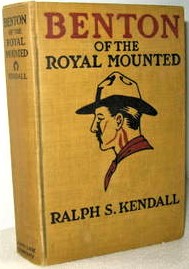
And See Our Latest Posts at CivilizedBears BLOG!
Are You On LinkedIn? Meet Me on LinkedIn Now! We Can Connect.
DID YOU LIKE THIS MOUNTED POLICE BOOK REVIEW? PLEASE SHARE WITH YOUR FAMILY, FRIENDS & FOLLOWERS!